Augmented SDPC
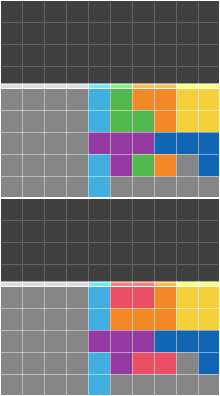
SDPC is an 8l pc continuation of the singleyou opener,
which has the following first bag setup :
.png)
.png)
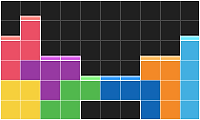
Default setup
T-spin requirements :
not [TZ]!O without mirror
not [TSZ]!O with mirror
.png)
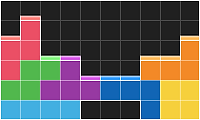
Alternative placement
No build cover contribution
Slightly better finesse
.png)
For people with maximum urge to sdpc at all costs.
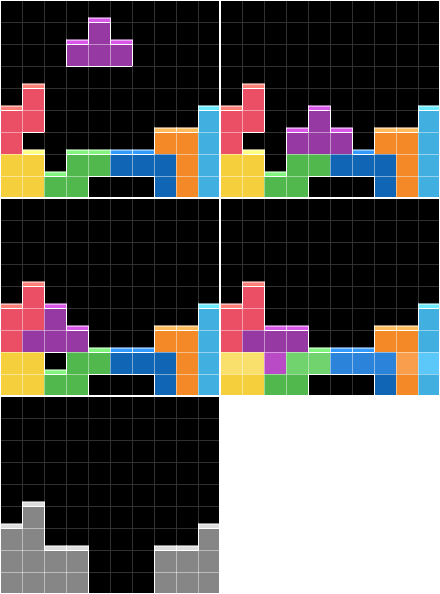
T-spin sequence
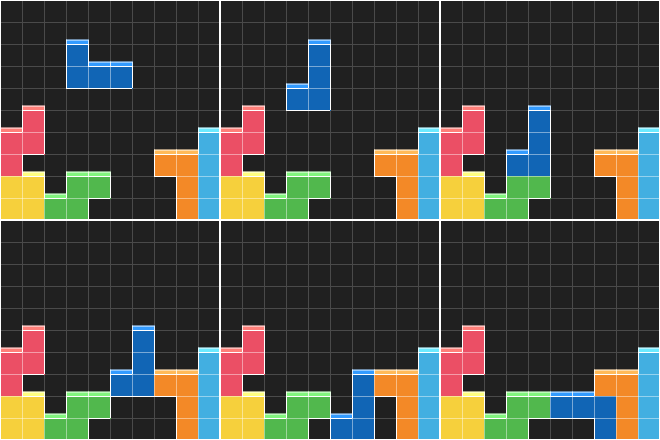
Sometimes need to softdrop J.
Advised to follow this sequence.
sd - das right - ccw
Hold on to softdrop.
No need to let go.
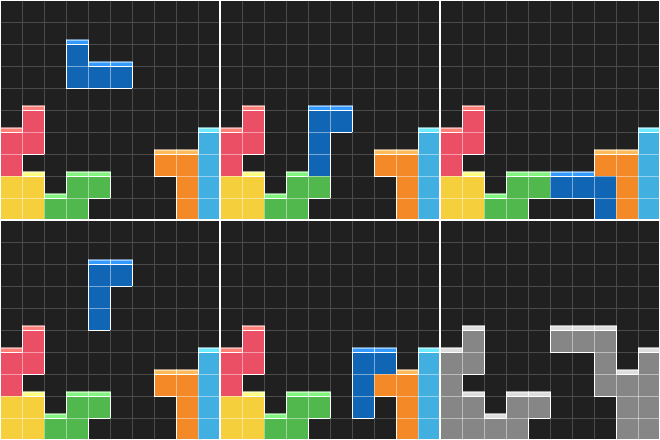
Different sequences of J may lead to fatal misdrops
.png)
Check out laundryspin for this misdrop
.png)
Residue after first bag
There are multiple awesome second bag setups:
Click on the images to jump to section :
Default set :
.png)
sdpc default
~ 98.45% pc
4962/5040 (78 fail)
.png)
sdpc alt o
~ 99.13% pc
4996/5040 (44 fail)
.png)
sdpc hold o
~ 99.68% pc
5024/5040 (16 fail)
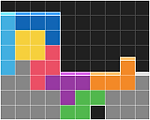.png)
sdpc alt j
~ 99.76% pc
5028/5040 (12 fail)
.png)
sdpc hold j
100% pc
5040/5040 (0 fail)
Extra set :
.png)
sdpc motchi fallback
~ 99.96% pc
5038/5040 (2 fail)
.png)
sdpc motchi
100% pc
5040/5040 (0 fail)
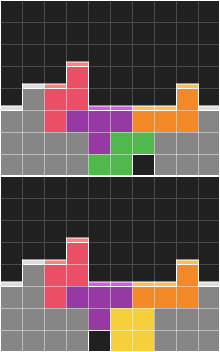
Note that very few pieces are needed for a tsd.
TLZ pieces are always placed the same way.
It is possible to dump these pieces first and then choose which path to go for based on the queue.
You may want to learn the fail queues for each path if you want to make theoretically optimal choices.
SDPC
default
%20(1).png)
.png)
~ 98.45% pc
4962/5040
78 fail queues
10 minimal solves
sdpc default solve :
this setup is always buildable with any bag, but also always avoidable with any bag.
can be categorized into 5 categories, with some additional solves you might like.
has the least pc chanc, but will serve as the foundation of other setups.
IOL base :
100% if IOL base can be placed immediately
.png)
.png)
.png)
.png)
.png)
IOJ base :
use different solve if this base has no solve
.png)
.png)
.png)
JSZ base :
may need funny spins, has save O/T solve
.png)
.png)
.png)
L skim :
easy to spot,
has save I solve
.png)
.png)
.png)
misc. :
not very intuitive but needs for full pc%
.png)
.png)
.png)
.png)
Extra solves :
below are just extra, not necessary for full pc% in sdpc default, but may be useful and may need in other setups
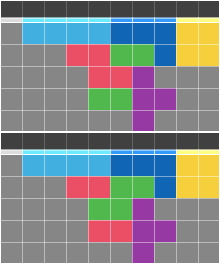
greedy tspins :
for full tspin chance, but saves into L/J
.png)
.png)
L skim extra :
one more solve for the L skim base
.png)
.png)
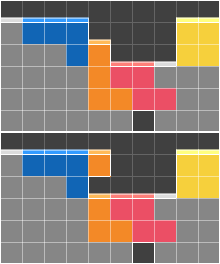
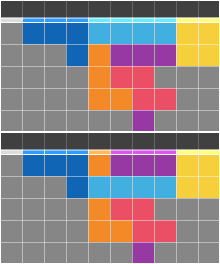
misc. extra :
sometimes useful
not hard to spot
Tips
-
Fail queues are the following :
xxxxTJL, xxxT[OJL]!
xxx ( xT / TJ / TI ) ZO
-
Categorizations are only for categorization and are arbitrary.
Solves may also be useful out of order.
-
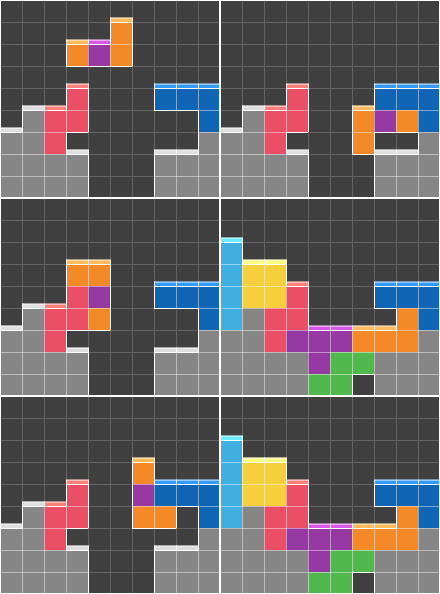
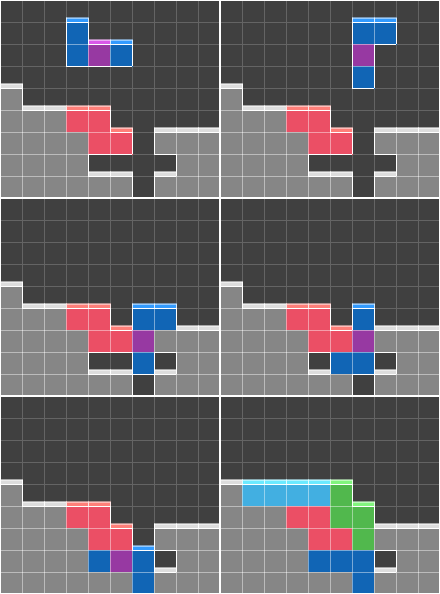
In the 2nd bag, you may have to tuck in the L piece like in the first sequence in the right.
This sequence allows you to avoid gravity wait.
Other sequences exist but this is more advised to prevent misdrops.
Do not hold on to softdrop for too long and do hold on to left until the end of sequence.
Holding on to right will prevent any misdrops happening due to gravity.
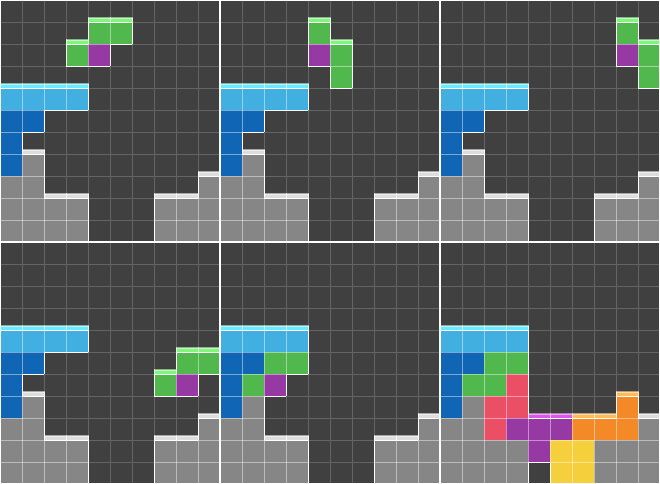
Center of rotation colored purple for clarity.
sequence 1 : ccw - sd - 180 - right - cw - 180
-
If IOL base can be constructed immediately, remaining field is always solvable.
-
If T is accessible immediately, field is always solvable.
The first misc. solve and the three t-spin solves are the only ones needed in this case.
-
Do not construct IOJ base without thinking.
Although the solves are useful, you need to use a different solve for some queues.
-
Notice that the O piece is always in the same position, only except for one JSZ base solve.
In other words, O can always be placed the same way unless there is a need for JSZ base.
-
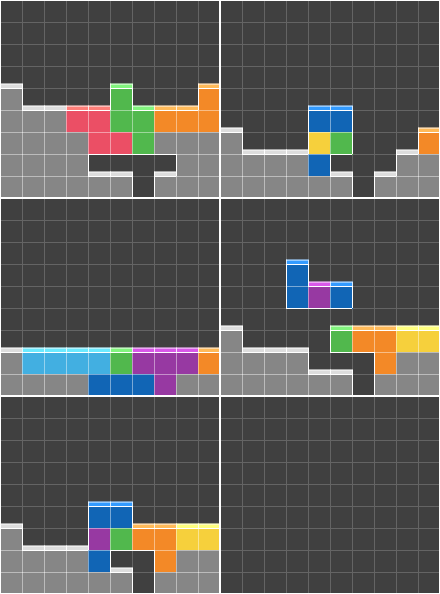
You may find the bottom two sequences on the right useful in JSZ base.
sequence 2 : Center of rotation colored purple for clarity.
cw - right - right - sd - 180 - ccw
sequence 3 : Center of rotation colored purple or yellow for clarity.
cw - sd - cw
-
Note that the last L skim solve and the last misc. solve are technically the same solve.
Still in a different category because it may be hard to imagine a T skim instead of a T-spin.
-
17 solves are listed here, but the actual minimal number of solves is 10.
More solves are intentionally included for consistency and intuitivity.
-
The extra solves are not necessary and does not contribute to pc chance.
However, they are still useful solves and are necessary for other 2nd bag setups below.
SDPC
alt O
%20(1).png)
.png)
~ 99.13% pc
4996/5040
44 fail queues
20 minimal solves
sdpc alt o solve :
this part assumes familiarity with the sdpc default section above.
all sdpc default solves above (with one obvious exception) including the EXTRA solves are also needed for full pc chance.
only solves that are not in the above are listed.
alt IOL base :
identical to default
can use same solves


double <3 :
may include skims (total 12 solutions)
.png)

alt L skim :
one more L skim
also useful fallback
.png)
.png)
I-spin :
single heart + I-spin
T may be in heart

.png)

.png)
misc. :
single heart + I skim
beware the T


.png)
.png)
Tips :
-
Fail queues are the following (not practically memorizable though) :
xx ( xS / xI / IZ / IO ) TJL
xx ( S[ZT]! / Z[ST]! ) IO
xx (xZT / STZ ) OI
xxZ[TL]!OI, xxZ[IT]!OL
xxSTJOI, xxIOJTL
-
Categorizations are just for categorization. Solves may also be useful out of order.
-
Note that the leftmost O placement is congruent with sdpc default.
-
Note that alt IOL base is exactly congruent with default IOL base.
Everything that applies to default IOL base therefore also applies to alt IOL base.
-
Some solves are both an IOL base solve and a double heart solve. Shown in both categories.
-
Double heart solves also show some sdpc default solves just for consistency.
-
If T is accessible immediately, field is always solvable.
All T-spin solves can be used to always solve the field.
-
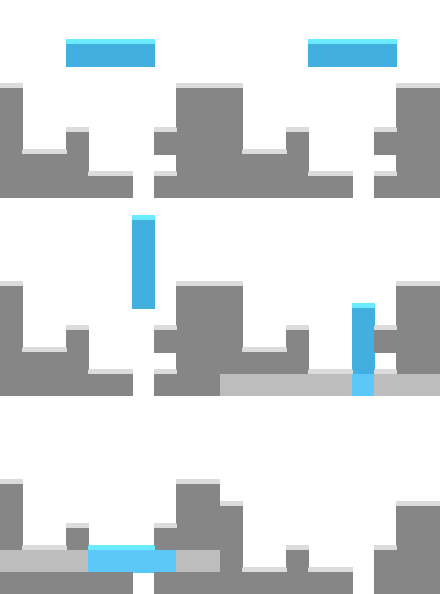
I-spin for the I-spin solutions is not one of those cursed I-spins.
It is done even without the use of any kicks. Sequence is shown in the right (cw - cw)
-
The last solve of the I-spin category may require a long S-spin sequence.
Sequence is shown in the right. Hold on to softdrop, no need to let go.
Center of rotation shown as red for clarity.
( right - sd - cw - cw - 180 - any 90 ) or ( das right - left - sd - ccw - ccw - 180 - any 90 )
-
Note that there is a "heart dependency" in the left side of the field.
It is always filled with the "heart" shape.
-
The misc. solves here might also resemble some of the misc. solves in sdpc default.
-
More solves than the minimal are intentionally included for consistency and intuitivity.
SDPC
hold O
.png)
~ 99.68% pc
5024/5040
16 fail queues
12 minimal solves
%20(1).png)
sdpc hold o solve :
this part assumes familiarity with the sdpc default and sdpc alt o section above.
no new solves other than sdpc default and sdpc alt o needed for full pc chance
hold o has only 12 minimals, even less than 20 for alt o. definitely worth giving extra attention to these solves.
also note that it is effectively see 8 even in a see 7 environment due to bag structure.
IOL base :
the identical base
can use same solves

double <3 :
may include skims (total 12 solutions)

JSZ base :
may need funny spins has save O/T
%20(1).png)

L skim :
all three L skims in one
helpful to know all
S-spin :
the funny solve from the I-spin category
%20(2).png)
%20(1).png)

%20(1).png)
misc. :
this one is from the misc. of sdpc default
%20(1).png)
%20(1).png)
Tips :
-
Fail queues are the following :
O - IxxSTJL
O - S ( Z / O ) xxTJL
O - Z ( IOS / Sxx / Oxx ) TJL
O - O ( IZS / Sxx / Zxx ) TJL
-
Note that all fail queues always end with TJL. The last L will not be visible before placing the O on hold.
-
Categorizations are just for categorization. Solves may also be useful out of order.
-
Note that IOL base and accessible T are both always solvable in both default and alt O.
-
No new solves other than sdpc default and alt O are introduced. Use the solves you already know and you are fine.
-
You may use the effective see 8 to your advantage if you wish to do so.
-
More solves than the minimal are intentionally included for consistency and intuitivity.
SDPC
alt J
.png)
~ 99.76% pc
5028/5040
12 fail queues
19 minimal solves
%20(1).png)
sdpc alt j solve :
this part assumes familiarity with the sdpc default section above.
only the L skim solve of sdpc default shown above is needed with the below solves are needed for full pc chance.
sdpc alt j is probably the most complicated and dynamic route of all.
it has 19 minimal solutions, technically one less than alt o, but solves vary a lot in shape which makes it harder to learn.
it is still good to know all other default solves.
only solves that are not in the above (with exceptions due to some falling into a category below) are listed.
JZI base :
probably the easiest set to remember
%20(1).png)

%20(1).png)
J base :
other solves with
the same J
%20(1).png)
%20(1).png)
%20(1).png)

<3 + T :
heart and I are
always on same side

%20(1).png)

%20(1).png)

antijeremy + T :
also has heart
but upside down



%20(1).png)
JS + Z base :
Z base instead of T
basically antipco

.png)

.png)
TS + Z base :
another Z base
basically hill
%20(1).png)

%20(1).png)
jaws :
awesome Z spins
often out of order
.png)
%20(1).png)

%20(1).png)
misc. :
useful fallbacks
needed for full pc%


%20(1).png)

Tips :
-
Fail queues are the following :
xxxJTIZ
xxSTZJI
xxTJ[SZ]!I
-
Categorizations are just for categorization. Solves may also be useful out of order.
-
Note that the rightmost J placement is congruent with sdpc default.
-
Note that there are two J bases, two T bases, and two Z bases.
The last two categories might be arguably called an S base, if it makes sense to readers.
-
The T base solves always have symmetry. Look closely to the field after placing the T.
-
Note that the heart part in heart+T solves are always in the same side with the I piece.
-
Heart+T also has one default solve, included for consistency.
-
JS+Z base may resemble antijeremy+T, but a Z piece instead of a T piece.
-
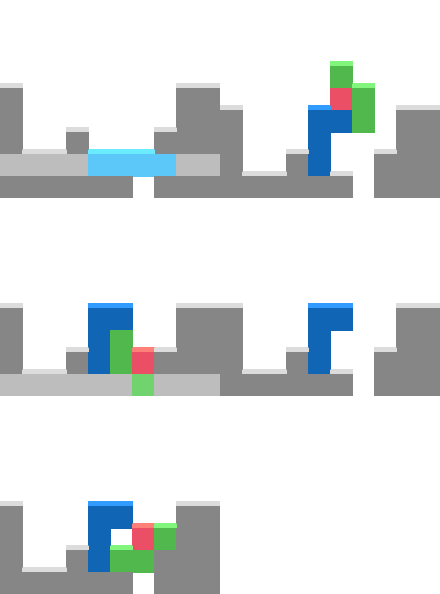
JS+Z base solves frequently have I- or Z-spin chances. Shown in the right.
sequence 1 : right - ccw - sd - cw
sequence 2 : hold on to softdrop, no need to let go (center of rotation colored purple)
( right - cw - sd - cw - 180 - any 90 ) or ( das right - left - sd - ccw - ccw - 180 - any 90 )
sequence 3 : hold on to softdrop, no need to let go (center of rotation colored yellow) :
sd - das right - ccw
-
jaws solve may need a Z-spin. Shown in the right.
sequence 4 : hold on to softdrop, no need to let go (center of rotation colored yellow) :
sd - das right - ccw
-
There are lots and lots of solves that are worth paying attention.
It is advised to take time to practice and explore the solves.
-
More solves than the minimal are intentionally included for consistency and intuitivity.




SDPC
hold J
.png)
100% pc
5040/5040
0 fail queues
7 minimal solves
%20(1).png)
sdpc hold j solve :
this part assumes familiarity with the sdpc default and sdpc alt j section above.
only one more solve other than sdpc default or sdpc alt j shown above is needed for full pc chance.
sdpc hold j is probably the best and easiest route of all.
it has only 7 minimal solutions, even less than 10 for default, so hold j is definitely worth learning.
also note that it is effectively see 8 even in a see 7 environment due to bag structure.
it is still good to know all other default and alt j solves. only the minimal solves are listed below.
default :
soles exclusively
from sdpc default
.png)
.png)
.png)
alt j :
solves exclusively
from sdpc alt j
.png)
.png)
.png)
both :
solves from both
default and alt j
.png)
.png)
.png)
neither :
one new solve
for 100% pc
.png)
.png)
Tips :
-
There are no fail queues. 100% pc chance. Do not ever fail to pc from here.
-
Categorizations are just for categorization. Solves may also be useful out of order.
-
Note that the rightmost J placement is congruent with sdpc default
and the leftmost J placement is congruent with sdpc alt J.
-
The 7 solves above are all you need to know for 100% pc chance. Very easy to solve.
-
The solve shown in the right may also be sometimes useful.
-
You may use the effective see 8 to your advantage if you wish to do so.
-
It may be possible to try optimizing solve chance even before placing several 2nd bag pieces.
Look at the queue for the first few pieces of bag 3 and try to see if there are one or more set of solves you can use for every possible sequence of the unknown pieces.
In other words, try to qb/oqb without commiting too many pieces if that sounds good to you.
Out of order solves may also be useful.

SDPC
motchi fallback
.png)
~99.96% pc
5038/5040
2 fail queues
15 minimal solves
.png)
sdpc motchi fallback solve :
this part is an extra setup. this setup can always be built for any bag.
some solves may be in multiple categories at the same time in this section for consistency. do not be confused.
there are no tetris solves due to the I dependency in the left, but still has some T-spin chance.
T-mini base :
SO base possible
not hard as it looks
.png)


.png)
JT skim :
leaves o + heart
can be placed last


.png)

LJ base :
2 easy solves
useful to remember

.png)
.png)
L base :
alt J congruent
but instead uses L
.png)



SO base :
has overlap with
T-mini and ZO base
.png)




ZO base :
choose wisely of two
note the first solve

.png)
.png)

Tips :
-
Fail queues are the following :
[LS]!TJZOI
-
Categorizations are just for categorization. Solves may also be useful out of order.
-
Note the I dependency in the left. The I piece always goes there.
-
The T-mini and SO base are interesting enough to share many solves.
Arguably deserves its own category. Compound base shown in right.
-
Also note that the first solve of ZO base is congruent with the first solve of SO base.
OSZ ball part of the solve shown in right.
-
Note the Z placement in the last solve of SO base and the last solve of ZO base.
This placement is also interesting enough that it arguably deserves its own category.
One extra solve for this placement shown in right.
-
The L base is congruent to sdpc alt j with an I vertically placed in right.
Although the field is congruent, this time it used L instead of J, so beware the queue.
-
ZJ base might arguably also be a thing like shown in right. Useful solves to remember.
-
Despite of its high pc chance, extra setups may not have many T-spin solves.
If you are down for sacrificing pc chance for T-spins or tetrises,
it may be better to stick with the default set rather than the extra set.
-
During setup, S can still be placed after placing I if Z is not yet placed.
Center of rotation colored purple for clarity. Shown in right.
( cw - das right - sd - ccw - das left )
-
More solves than the minimal are intentionally included for consistency and intuitivity.



SDPC
motchi
.png)
100% pc
5040/5040
0 fail queues
14 minimal solves
.png)
sdpc motchi solve :
no fail queues. do not ever fail to pc here.
this part assumes familiarity with the sdpc motchi fallback section above.
all motchi fallback solves can be reused out of order in many cases, but not as often as you might think.
below solves combined with all motchi fallback solves will let you always pc here.
only solves that are not in motchi fallback are listed below.
IL base :
may still resemble
some fallback solves

.png)
.png)
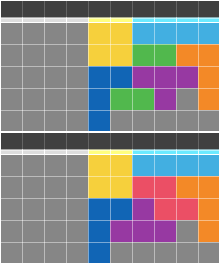
wrong default :
weird sdpc default
but not default solve
.png)
.png)
.png)
.png)
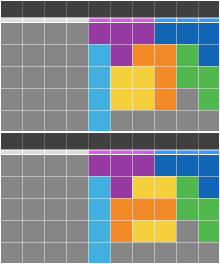
JS base :
potential tet solve
has grace solve

.png)
.png)
Tips :
-
There are no fail queues. Do not ever fail to pc here.
-
Categorizations are just for categorization. Solves may also be useful out of order.
-
All sdpc motchi fallback solves can be used, frequently out of order.
-
Solve in the right may also be useful. Also a potential tet solve.
-
Although not always, note that the I piece in IL base will probably be out of order in many cases.
-
Note that J is always vertical in IL base and always horizontal in the other two bases.
-
Note that I is horizontal only in IL base and the grace solve,
otherwise vertical in leftmost column.
-
Despite of its high pc chance, extra setups may not have many T-spin solves.
If you are down for sacrificing pc chance for T-spins or tetrises,
it may be better to stick with the default set rather than the extra set.
-
More solves than the minimal are intentionally included for consistency and intuitivity.